REVIEW · COPENHAGEN
Explore Copenhagen: Self-Guided Audio Tour
Book on Viator →Operated by Citywalksz Ltd · Bookable on Viator
A simple download makes Copenhagen make sense. This self-guided audio tour in English strings together major sights with stop-by-stop guidance so you can see the city’s big architecture without waiting around. You start near Rådhuspladsen and can finish by Tivoli Gardens, all on your schedule.
I like two things most. First, the tour is built around pre-downloaded audio and a map, so you are not stuck fighting for a GPS signal. Second, the stops are smartly chosen: City Hall, the Round Tower, Rosenborg, Frederiks Kirke, Amalienborg, the Royal Danish Theatre area, and the Christiansborg complex kitchens.
The main caution is audio quality. The experience is mostly about sound, and some people found the audio hard to hear with muffled background effects and staticky sound when played loud. If you care about clear narration, bring decent headphones and test volume before you walk out.
In This Review
- Key points to know before you start
- Price and what you actually get for $15.29
- Getting the tour files right: the download workflow that keeps you on track
- The walking route: start at Rådhuspladsen, end by Tivoli
- Stop-by-stop guide: what to look for and what you’ll learn
- 1) Copenhagen City Hall: brick drama and a clock tower attitude
- 2) The Round Tower (Trinitatis Complex): a spiral ramp to the sky
- 3) Rosenborg Castle: Dutch Renaissance showmanship for the Christian IV era
- 4) Frederiks Kirke (Marmorkirken): Scandinavia’s big dome and a planned district
- 5) Amalienborg: where Denmark’s royal family lives, not just poses
- 6) Royal Danish Theatre play house: from French comedies to major performing arts
- 7) Royal Kitchens of Christiansborg Palace: layers of castles and a famous prisoner story
- How long you’ll actually spend at each stop (and how to keep momentum)
- What the self-guided format gets right (and what to watch)
- Why it’s good value
- The biggest practical win
- The audio is the risk
- Who should book this tour
- Should you book? My decision checklist
- FAQ
- FAQ
- How long is the Copenhagen self-guided audio tour?
- What does the tour cost?
- What language is the audio available in?
- Where does the tour start and end?
- Is the tour self-paced or does it follow a schedule?
- Are admission fees included for the stops?
- Do I get an audio device with the ticket?
- Do I need to download the audio before I start?
- What type of walking level should I expect?
- Can I cancel for a full refund?
Key points to know before you start
- Download-first setup: you get a zip file with a map and multiple audio tracks, not just a basic GPS app.
- Designed for a 2 to 3 hour loop: each stop is paced for quick viewing with narration in tow.
- No admission included: you’ll still need to budget entry fees for places that charge.
- Seven historic stops, one main theme: Copenhagen’s landmark architecture and power centers.
- Phone required, audio device not included: you’ll need your own phone and headphones.
- Moderate walking level: plan for a few active blocks between stops.
Price and what you actually get for $15.29
For $15.29 per person, this is a budget-friendly way to get structured context at Copenhagen’s most famous landmarks. You are not paying for a guide. You are paying for the “thinking part” of sightseeing—what you’re looking at and why it matters—delivered through your phone.
Here’s what’s included: audio files and a GPS map plus a self-paced setup. You also get a mobile ticket in your booking. What’s not included is just as important: admission fees, transportation, and food/drinks. Also, you do not get an audio device, which means you’ll rely on your own phone (ideally with headphones).
Duration is listed as about 2 to 3 hours, and each stop is paced at roughly 15 minutes. That tells you the tour is meant for “see it, learn it, move on,” not long museum time. If you want to linger in castles or churches, you’ll need to add time.
Group size is limited to a maximum of 50 travelers, but since it’s self-guided, that mostly matters for how the provider organizes digital materials—not how crowded the sidewalks feel.
Other self-guided audio tours we've reviewed in Copenhagen



Getting the tour files right: the download workflow that keeps you on track
This experience is built around preparing your phone before you start. The tour instructions say you should download the audio file and have it ready before you begin. One person’s experience described the setup as a zip file you unzip to reveal a map and 13 audio files, rather than a system that constantly begs for GPS to work.
That design choice matters in Copenhagen, where street corridors can look similar and where you don’t want your day hinging on a spotty connection. You can still use your phone’s location tools if you want, but the tour’s structure is meant to guide you even if GPS is flaky.
My practical advice:
- Download on Wi-Fi, then open and test the first audio track before you head out.
- Fully charge your phone. You’re using it as a screen, a player, and navigation.
- Use headphones. City noise will otherwise eat the narration.
And yes: if you are tempted to listen at max volume, remember the audio-quality caution. Better sound usually beats louder sound.
The walking route: start at Rådhuspladsen, end by Tivoli
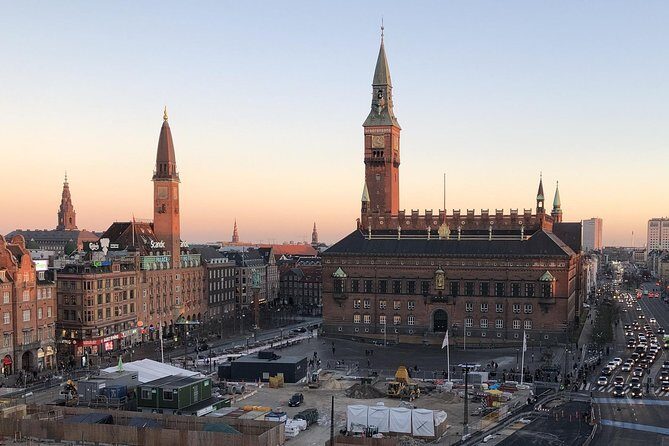
Your stated start is Rådhuspladsen (1599 Copenhagen) and your end point is Tivoli Gardens, Vesterbrogade 3, 1630 København V. Since it’s self-guided, you can start at your chosen time (the tour listing mentions a 9:00 am start) and finish whenever you’re ready.
Think of it as a city-center “great hits” march. You’ll hop between political landmarks, royal buildings, and major cultural sites. The route is not described as step-free or wheelchair-specific, but it does note moderate physical fitness. That usually means you should be comfortable with sidewalks, stairs if you choose to enter buildings, and some time standing still to read facades.
Stop-by-stop guide: what to look for and what you’ll learn
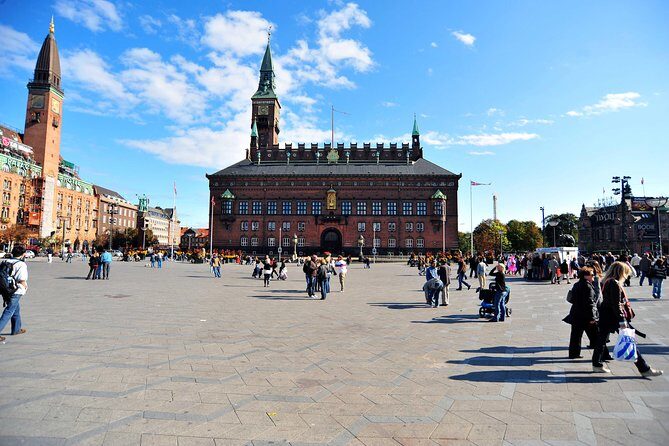
1) Copenhagen City Hall: brick drama and a clock tower attitude
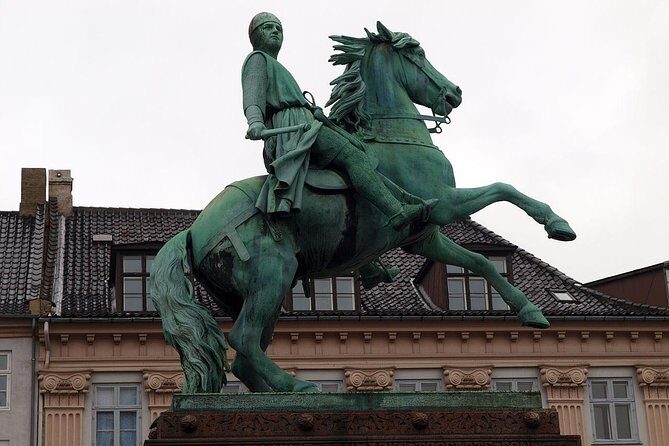
Your first stop is Copenhagen City Hall in City Hall Square, which the tour highlights as the city’s largest square. This building is instantly recognizable thanks to its ornate brick frontage, its clock tower, and the gilded statue of the city’s founder, Bishop Absalon, over the front balcony.
The tour framing here is the style story. City Hall was built in the National Romantic style, popularized by architect Martin Nyrop. And there’s a fun connection you’ll hear: Nyrop’s design inspiration points to the City Hall in Siena, Italy. That kind of link helps you see Denmark’s big public buildings as part of a wider European design conversation, not just local decoration.
Even if you only pause for a few minutes, focus on the facade rhythm: how the brickwork, tower, and sculpture create a strong “center of gravity” for the square.
Note: the tour lists admission ticket not included, so if you want any interior viewing, check on-site.
Other guided tours in Copenhagen





2) The Round Tower (Trinitatis Complex): a spiral ramp to the sky
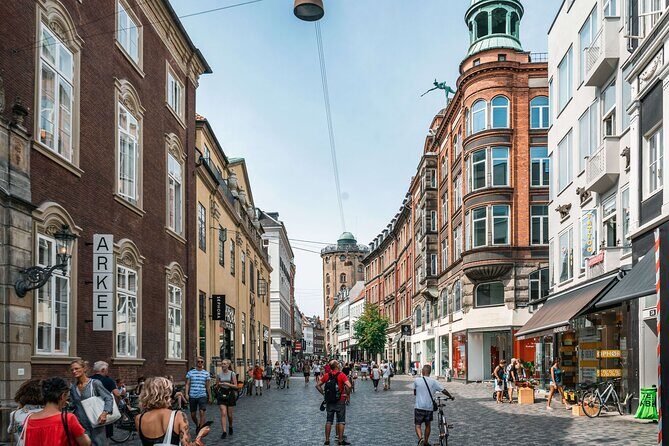
Next up is the Round Tower, a 17th-century astronomical observatory and part of the Trinitatis Complex, which includes Trinitatis Church and an academic library tied to Copenhagen University.
The library detail is one of the more specific nuggets: it opened in 1657 and once held the university’s entire collection—about 10,000 books. That’s a reminder that this wasn’t just “pretty buildings on a hill.” It was a working brain.
Here’s the design you’ll want to notice: instead of stairs, the tower uses a spiraling ramp that winds up to the top. Even if you don’t go all the way, the ramp concept changes how you picture the structure. It’s astronomy designed to be reached—not just admired.
Again, admission is not included, so plan on possible entry fees if the tower or areas charge.
3) Rosenborg Castle: Dutch Renaissance showmanship for the Christian IV era
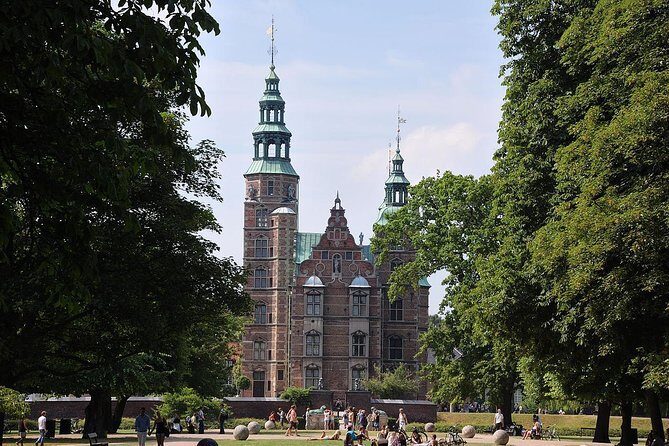
At Rosenborg Castle, you’ll get the royal-building backstory tied to King Christian IV and his many architectural projects.
The tour calls out the architecture as Dutch Renaissance with high gables and spires—the kind of detailing that makes you stop and look up without even meaning to. Construction history also matters here: after initial completion, the castle kept expanding, reaching its current form in 1624.
This stop is great for quick “spot the style” learning. Try this: stand back and identify where the spires and gables pull your eye. Then imagine the building as a royal statement piece—power made visible in stone.
As with the others, the audio tour notes no admission ticket included, so if you want to go inside, budget extra.
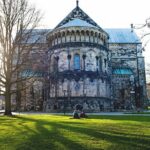
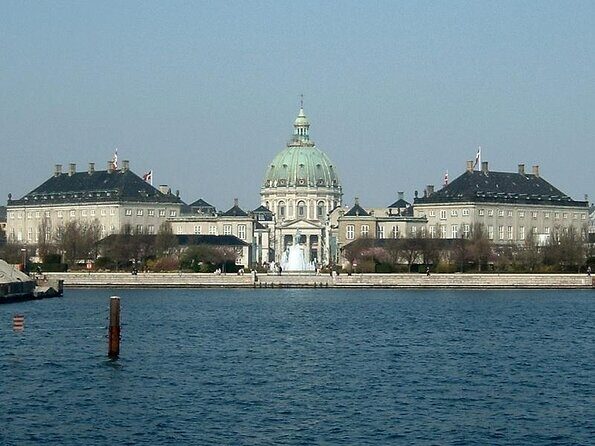
4) Frederiks Kirke (Marmorkirken): Scandinavia’s big dome and a planned district
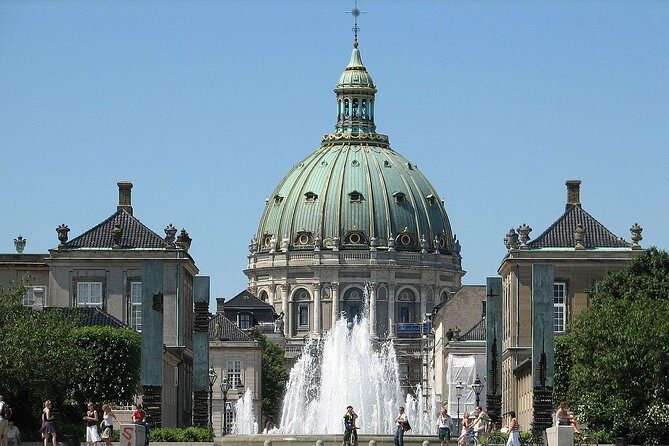
Now you’ll shift to one of Copenhagen’s most famous church silhouettes: Frederiks Kirke, also known as Marmorkirken or Frederik’s Church.
The tour highlights a key claim: it has the largest church dome in Scandinavia. That’s the kind of fact that makes your photos look better, because you know you are looking at a record-setting structure—not just a pretty church.
You’ll also get context about why this church shows up where it does. In 1748, planning began for a grand city district called Frederiksstaden under King Frederik V. In other words, this isn’t random. It’s part of a bigger urban vision.
If you only have a few minutes, do this: take in the dome first, then scan the exterior for the symmetry lines that make the building feel so monumental.
Admission is listed as not included.
5) Amalienborg: where Denmark’s royal family lives, not just poses
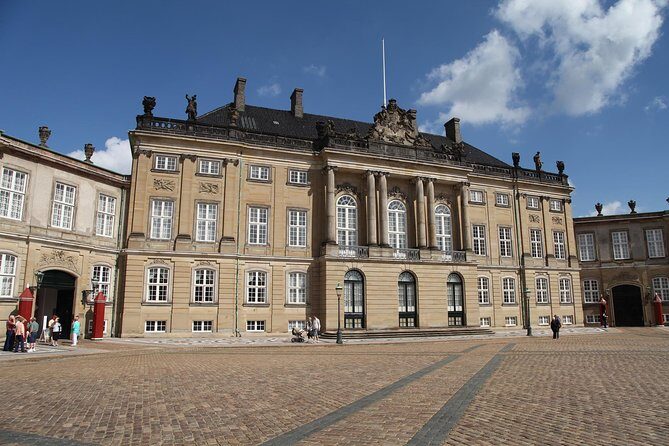
Next is Amalienborg, the current residence of the Danish royal family. The tour explains that the first palace was built between 1669 and 1673 by Queen Sophie Amalie, wife of King Frederik III.
But the version you’ll see today is linked to a major reset. Frederik V dismantled the existing palace and replaced it with the octagonal complex that defines Amalienborg. The tour frames this as the crowning centerpiece of the district of Frederiksstaden.
This stop is ideal for learning how royal space works in Copenhagen. You’re not just viewing a monument. You are looking at an active residence designed to project ceremony and order.
Take a minute and look for how the building edges and open space shape the square feeling around it. Royal architecture loves geometry, and this complex is built to feel intentional.
Admission is not included.
6) Royal Danish Theatre play house: from French comedies to major performing arts
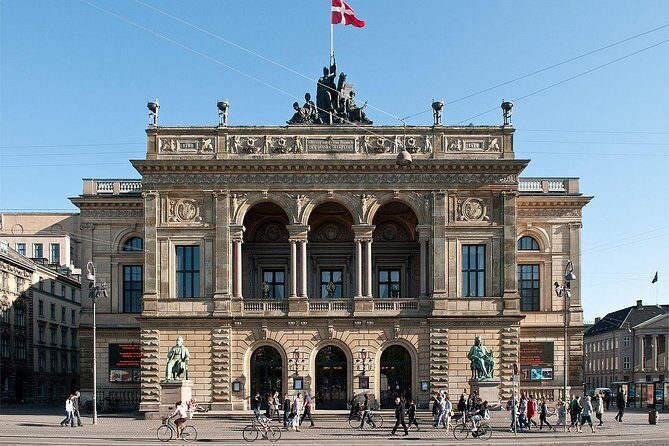
Your audio-guided route then points you toward the Royal Danish Theatre complex.
You’ll learn a dated but vivid origin story: the first theatre at this location was built in 1748, seating 800 people. The tour notes the early troupe size—eight actors and four actresses—and says performances originally leaned heavily toward French comedies.
Then comes the practical problem: the original theatre proved too small. In 1774, it was rebuilt for a larger audience. From there, the Royal Danish Theatre became the home for major performing arts, including ballet, opera, and the royal orchestra.
Even without going inside, you can use this stop to look at how Copenhagen invests in culture. It’s not an afterthought. It’s built right into the city’s formal identity.
Admission is not included, and whether you can access interiors depends on current programming.
7) Royal Kitchens of Christiansborg Palace: layers of castles and a famous prisoner story
The final cultural/political heavyweight in the tour is the Royal Kitchens of Christiansborg Palace area.
Christiansborg Palace is described as built over the remnants of four previous castles. The story starts with Absalon, who constructed the first castle on the island in 1167 for over 200 years. Then comes destruction: Absalon’s castle was destroyed by the Hanseatic League, and Copenhagen Castle was built over the ruins for several hundred more years.
A detail to hold onto: the tour mentions the Blue Tower, which held Leonora Christina, daughter of Christian IV, captive for almost 22 years. That’s a heavy human story tucked under the tour’s architectural focus.
If you’re into context, this stop is the moment where Copenhagen stops being just scenic. It becomes political—who ruled, who was punished, and how power left marks in stone.
Again, admission ticket not included.
How long you’ll actually spend at each stop (and how to keep momentum)
The tour is paced for about 15 minutes per listed stop. In real life, that’s enough time to:
- take in the main facade,
- catch the audio narration highlights,
- snap a couple photos,
- and move on before you start resenting your own legs.
If you want to include interiors, you’ll need to adjust. Since admission fees aren’t included, you’ll also want to decide ahead of time which places are worth paying for. Think of this as a choose-your-own-depth tour.
What the self-guided format gets right (and what to watch)
Why it’s good value
You’re paying for guided structure, not a guide’s time. For $15.29, that’s a strong deal if you want a coherent story across multiple landmarks in a short window.
The biggest practical win
The tour appears built to work even when you are not relying entirely on GPS. The downloadable map and instructions mean you can keep moving with confidence, and you’re not stuck hearing directions that go nowhere.
The audio is the risk
Clear audio is everything in an audio tour. If your phone speakers are weak or you use cheap earbuds, you might miss details. The caution from the feedback you were provided is real: some people reported background sounds and effects muffled, and audio turned staticky when played loudly. So use a practical approach:
- keep volume at a level where narration stays clear,
- use headphones,
- and avoid blasting the speaker if you notice distortion.
Who should book this tour
This self-guided Copenhagen audio tour is best for you if:
- you like landmarks but don’t want to pay for guided touring,
- you want a quick, organized path through the city center,
- you’re comfortable using your phone for audio and map guidance,
- and you’d rather control pace than stick with a group schedule.
It’s less ideal if:
- you know you hate audio tours,
- you have unreliable phone battery,
- or you require consistently high audio clarity for comprehension.
Should you book? My decision checklist
Book it if you want a structured, budget-friendly way to learn why Copenhagen’s major buildings look the way they do. The price-to-coverage ratio is strong for an English self-guided format that covers City Hall, the Round Tower, Rosenborg, Frederiks Kirke, Amalienborg, the Royal Danish Theatre area, and Christiansborg’s royal kitchens.
Skip it if audio quality is a deal-breaker for you. If you’ve had bad luck with hearing narration on phone-based tours, bring tested headphones or plan to read signage when audio gets unclear.
Either way, download your files before you start. That single step is the difference between a smooth afternoon and a frustrating one.
FAQ
FAQ
How long is the Copenhagen self-guided audio tour?
It’s listed as about 2 to 3 hours.
What does the tour cost?
The price is $15.29 per person.
What language is the audio available in?
The audio is available in English.
Where does the tour start and end?
It starts at Rådhuspladsen (1599 Copenhagen) and ends at Tivoli Gardens, Vesterbrogade 3, 1630 København V.
Is the tour self-paced or does it follow a schedule?
It’s self-paced. You choose your own starting point and ending point according to your schedule.
Are admission fees included for the stops?
No. Admission fees are not included.
Do I get an audio device with the ticket?
No. You’ll need to use your own audio device (the instructions say to prepare the audio file for your smartphone, and an audio device is not included).
Do I need to download the audio before I start?
Yes. You are instructed to download the audio file and get it ready before your journey.
What type of walking level should I expect?
The tour notes you should have a moderate physical fitness level.
Can I cancel for a full refund?
Yes, you can cancel for a full refund if you cancel at least 24 hours before the experience start time (cut-off based on local time).